Sunday, July 28, 2013

Taste, taste, baby...

Hey, hope everyone's enjoying their weekend.

I LIVE for my weekends - grad school is grad school, but the weekends are a time for me to decompress from the stresses of the week and enjoy some time with MOH, my pets, and get some me time. This weekend's adventures entailed driving MOH to different comic book stores in the Orange County region to find his precious Green Arrow comics.


The highs of Comic-Con have not worn off for us, and MOH's decided to get back into comic collecting. I don't mind driving MOH around, and even feeding into his new hobby (it's really cute when you get to experience how excited someone can get over comics, or in general with something they're passionate about, and MOH is no different). Everything aside, one great thing about running around town, especially to places we don't go to often, is to try new places to eat! We've heard so many great things about this little bakery called Cream Pan in Tustin, and it did not disappoint.

We decided to order the strawberry croissant because there's so much YELP-mania on it, and for good reason. What makes a great croissant? For me, a croissant must be flaky to the bite, buttery and lightly salted. This croissant, per Chandler Bing, "was perfection." Everything about it was delicious. You got the fat croissant, creamy (yet light) sweet custard, and tart strawberries to cut into the custard and croissant really well. At the register, there was a man before me that ordered two plastic trays of the strawberry croissants (they're a little smaller than the palm of your hand), with each tray containing maybe 10 croissants. I'll admit, I was a bit judge-y but after biting into my croissant in the car and scarfing it all before leaving the parking lot, I'm not passing judgement anymore!

Probably the best food on anyone's list of must-eats is composed of food that has managed to tickle a combination of our taste buds, whether it's a sea salted caramel yogurt, apple-bacon donuts, or even the nostalgic warheads! 

Fluorescent taste buds (Tizzano et al., 2008, BMC Neuroscience)
Taste buds don't just let us enjoy flavor, but initiate our gut for absorption of food (including the release of food-specific digestive enzymes and trigger our gut to make reflexive contractions). So how exactly do we sense taste? Well, remember how I told you taste buds have numerous cells packed together? Our taste buds contain multiple cell types (at least 4 known cell types). Each cell type is different in its own way, and has different receptors, or binding sites for food molecules to bind onto. Think of it like a lock and key fit, as in a sweet compound binds onto the sweet receptor in the taste bud. This method of detecting flavor is how we sense sweet, bitter and umami - salty and bitter molecules have the ability to pass straight through the cell for flavor detection, and thus, bypasses the need to bind onto a receptor.

Breakdown of the different types of cells that compile our taste bud! Each taste bud contains various different cells that have receptors for the 5 flavors (from Chaudhari and Roper, 2010)

After flavor molecules hit the taste buds, this activation leads to stimulation of gustatory nerves that send the food information to the brain for further processing.

Adapted from Merck Manual.com

So next time you're getting your foodie on, take time to appreciate just how delicious food can be! I know I'll be enjoying MOH's sea salted brownies! It's something that we definitely take for granted, especially considering how taste buds don't have the ability to regenerate as much when we get older.

Until next time, happy eating everyone!


The science in this blog comes from a comprehensive review of taste buds and how they signal taste information to the brain: Chaudhari and Roper, 2010, The cell biology of taste (Journal of Cell Biology).


Saturday, July 20, 2013

Comic-con withdrawal

I'm back from Comi-Con and I'm on withdrawal. MOH and I went to our very first Comic-Con (and certainly not our last!) and we had tons of fun. We were among the rare few attendees who were unable to go for the entire 4 day stint, as we just had passes for 3/4 days.


Comic-con is an international convention that revolves around panels, discussions, and exhibits all related to movies and TV shows, comics, and games. This year, Comic-con highlighted new games for PlayStation4 and Xbox1, and held panels featuring new TV show line-ups (the JJ Abrams robotics-crime drama, Almost Human), and long-time favorites (Breaking Bad, Walking Dead, and Game of Thrones). Did I mention you also get to pick the brains of producers behind some of the greatest movies/series?!?! Besides the exciting panels available, there are tons of exhibits featuring cool swag designed to make even the most composed person geek and spaz out. My personal favorite was the exhibit showing to-scale figurines of Star Wars, DC / Marvel  comic characters, and even JRR Tolkien's characters come to life.


Needless to say, I had a great time. I'm counting the days until I can go again (54 weeks and counting!). Besides the convention, another great thing to celebrate about going to San Diego was to try the infamous Extraordinary Desserts! This place did not disappoint.

We had drove down to San Diego, were running on low fuel and had no dinner. Regardless, we met up with some old friends in college who lived in Mira Mesa for a late night dessert. This restaurant doesn't just serve dessert, but go for a sweet treat. Don't get salad, or a panini - go here for the creme brulee, the chocolate cake, the passion fruit cheesecake. Seriously - get something sweet! I can't comment on the entrees or apps, but this place is called Extraordinary Desserts for a reason!


I ordered this decadent cake called The Viking. It has a chocolate creme brulee and milk chocolate cream underneath chocolate cake layers. On top, you have a chocolate almond praline to add a nice bite of crunch. This cake did not disappoint my sweet tooth. I'm a major chocolate-aficionado and love chocolate no matter what type of mood I'm in. Sad? Eat a double chocolate cookie. Mad? Eat chocolate chips from the bag (MOH has extra chocolate chips on hand for this occasion). Happy? Try for a kit kat if on hand. I eat chocolate every day. This cake is catered to the chocolate lover. To anyone who likes eating chocolate, don't order this. It's very rich. It's the by-product of if a brownie, german chocolate cake, and creme brulee got in a love triangle. A little bit risque, but soooo good. Everything about this cake was good. The topping of chocolate creme brulee had this great bite. The frosting was so rich and thick and had a great dark chocolate taste. The cake layers itself were so moist and melted in my mouth. Finally, the chocolate creme tasted like a chocolate mousse and just slid down my throat, coating this lovely chocolate layer for me to enjoy the whole way through. Really good. If you're not into chocolate, I'd still definitely recommend giving this place a try at least once. I've heard they have a dessert buffet and their other desserts are really wonderful as well. MOH had the creme brulee and let out a food-gasm upon the first bite. I tried it myself and it was quite tasty. 

Anyway, hope everyone's having a great weekend! Apologies if you were expecting a science-driven blog, but I'm still on cloud nine from Comic-Con. Be on the lookout for a blog on the taste buds next week!

Happy eating all!


Sunday, July 14, 2013

Autobiographical odor memories - Kit Kats at the beach

Ever reminisce back on your childhood and wish you could be a kid again?

I was at the beach recently, enjoying a warm summer evening with MOH and my sister and had a wonderful time. The air was salty, the waves were wildly crashing against the sandy shore, and my favorite part - we came just in time to see the sunset. 

When I came to my school for interview weekend, I remember asking a grad student how they liked living by the beach. I was a little bummed when the grad student said without hesitation, "you know, I've only been to the beach maybe 3 times throughout my whole grad school career... guess you don't really have time or need to go!" I was so surprised and figured maybe grad school was going to be too busy to take time to enjoy the ocean air. WRONG. I can't tell you how many times I've run away to the beach after a long day at lab, after seeing negative data that I busted working my ass off for, or just because I felt like collecting shells and eroded rocks for my little ocean collection. Maybe it's just me, but there's nothing that beats a day or even early evening spent at the beach. I'm secretly hoping that I can spend the rest of my life living off the beach - as in have my house so close to the ocean that the sand hits my feet once you step outside the house. Wishful thinking, probably borderline delusional dreaming considering the extravagant salary of a grad student! 


I think one more reason (of many) why I love the beach so much is because a majority of my best childhood memories happened at the beach. When I was little, much of my extended family lived near Monterey in a little town called Seaside. My family would regularly take weekend trips to visit my cousins, aunts, and uncles. We started this tradition where we would bring duck to make bun mang (bamboo duck noodle soup), and every weekend trip would end with a great day at the beach. I think my cousins thought the beach was overrated (they lived so close to it), but for me, every trip to Seaside wasn't complete without a trip to the beach, usually to Lover's Point (beautiful place, seagulls and squirrels are a bit too friendly, but so scenic and peaceful).


Whenever I think back on these trips, I always remember what I loved to eat whenever taking a trip to the beach - Kit Kats. Kit Kats taste amazing after jumping around in the waves. Your body is all salty and wet from diving into the waves, and eating Kit Kats go so good with it. It's similar to sea salt coated dark chocolate - that mixture of salty, sweet is a combination that anyone can appreciate. Try sea salt coffee? Or brownies dusted in kosher salt? Now, whenever I see Kit Kats, or even eat chocolate, I think back on those memories of being a kid, rocking a one piece Mickey Mouse suit with no shame, and strutting through the waters and sands without a care in the world, scarfing down those heavenly pieces of wafer chocolate-y goodness. 

So that brings us to this week's science content - are odor-mediated autobiographical memories even real? And are they as strong in our memories like other types of autobiographical memories? I was quite curious about this so I did a bit of digging and found some cool info tidbits on this good review (Larson and Willander, 2009). 

Before we dive into odor-autobiographical memories, let's just review a little on what's known about autobiographical memories. Autobiographical memories fall under the "episodic" memory category, and is a special type of memory in which you can actively recall the time or date when a particular memory happened. Things like when was your wedding, when did you finish high school, or how old were you when you got your first ticket? In terms of how far back you can recall autobiographical memories, researchers normally look at memory recall in terms of blocks of years, or intervals and have classified three main time intervals of autobiographical memory recall - the childhood amnesia, the "bump", and recency. 

Childhood amnesia refers to how difficult it is to remember many childhood memories, like when you finally learned how to ride a bike (unless you're MOH, who learned in college - sorry MOH!); the "bump" refers to how much easier it is remember key events between the ages of 10-30 years old, like when you met your first love; and finally, the recency refers to the ease of remembering more recent events readily compared to things that happened in the past. When you think about it, these three time periods make sense. I have the most difficulty remembering exact days when I tormented my sister, or when I ate dirt - in fact, these memories are mostly vague at best, or only remembered because of what my parents tell me. And of course, the most recent memories are easiest to recall - I can think back on what I did last week far easier than what I did three years ago (vaguely remember thinking going to grad school was going to be amazing and I was going to be a superstar - HA, yeah OK). Most of these studies looking at autobiographical memories have been conducted by testing subjects by verbal cues, as in asking them questions about when certain events happened. Less work has been done in the field of looking at odor-related autobiographical memories, however. 

Favorite childhood treat - fig newtons
The work that's been done in odor-autobiographical memories has suggested that odor-autobiographical memories are recalled more during early life. The subjects were presented with either an odor, word or picture and asked to recall a memory. The results showed that most of our odor-mediated memories come from our first decade of life, while verbal or visual-mediated memories are more readily recalled from 11-20 years of age. So more of our odor-memories occurring in our childhood are retained more readily than odor-memories happening later in life. I can totally attest to this. When I was a kid, I scraped my knee really bad from a bike ride. I attempted to scale a mountain (more like a hill, but things look different when you're a kid) that was all rocks at this construction site. I rode up the mountain on my kiddie dirt bike and ended up riding down the hill, but sliding and falling. I scraped my right knee really bad, so bad that rocks were embedded in it and I wailed like a weenie. My dad came running from a block away and helped me bandage my wound. Before putting a bandage on, he sprayed this pink antibacterial/antimicrobial mist on my knee and I screamed like nobody's business. I will never forget that methanol, alcohol smell. It burned and sizzled upon contact. To this day, when I smell disinfectant, I go back to that time when I thought I was good enough to ride up that thing. 

Deathly afraid of disinfectant, but I still love cycling - I go to this awesome place to do indoor spin at Costa Mesa called Full Psycle. If you're based in Orange County, try this place out!

Another interesting aspect of odor-autobiographical memories is the ability for these memories to "transport us back in time." Whenever I take trips to the beach, the salty smell of the ocean air always takes me back to being that awkward fat kid at Monterey, happily munching away at Kit Kats, with not a care in the world. It's amazing how strong food memories can be. You can just close your eyes, think of a certain food, like the smell of freshly baked cookies, and be transported away to a happier, simpler time. Or quite the opposite, smell something seemingly innocent, Italian meatballs, and suddenly feel sick to your stomach, recalling the last time you experienced horrible food poisoning (horrible night, stupid decision to eat expired Greek yogurt and Italian meatballs - ruined my love for yogurt for over a year). Probably one reason why olfactory memories seem so powerful and vivid compared to other memories, is the fact that the olfactory system connects directly to the emotional center of your brain, the amygdala - this is a theory, and so far, still under investigation. Another proposed idea of why odor-memories are so easily recalled over other types of memories could be that the olfactory bulb connects directly to the hippocampus, the neural hub responsible for memory formation. 

Olfactory circuit projects straight to key centers for emotional memory: the amygdala (emotional processing) and hippocampus (memory formation)

More work needs to be done in this area, but for sure, an interesting topic of investigation. 

Next week may be a weird posting, be forewarned. I'm heading to ComicCon, San Diego and may come back writing a post dedicated to food porn. On my to-do list is this amazing restaurant that I've heard raves about, Extraordinary Desserts, that I must go to. MUST GO TO. I keep bugging MOH about it.

To entice you, the creme brulee!

Until next time, happy eating!


References:
Larson M. and Willander J. Autobiographical odor memory. 2009. Annals of the New York Academy of Sciences. 

Olfactory-neural circuit courtesy of http://www.yalescientific.org/2011/05/the-neural-basis-of-olfaction/

Saturday, July 6, 2013

Quinoa - crazy!

Happy Independence Day weekend everyone! Hopefully some of you get to reap the joys of a 4-day weekend! For those who didn't, and had Thursday off only to come back to work Friday (me), here's to the weekend again!

Lately, I've been on a crazy quinoa kick. I mentioned in a previous posting about baking with quinoa into cranberry almond cookies, but what about making quinoa patties for the Fourth of July instead of grilling the traditional hamburger? Quinoa is so versatile! So let's backtrack on what exactly is quinoa and why everyone should try this little ancient grain at least once before dismissing it.


Quinoa is a favorite source of nutrition among vegetarians and vegans because of its high protein and mineral content (source: FAO.org). Quinoa, chicken and other meats, contains all the essential amino acids necessary for us to produce our body's source of protein - these food items are called complete proteins. Other sources of protein can come from grains or nuts, but they don't contain all the essential amino acids we need and are called incomplete proteins. Our body builds up muscle using 8 amino acids (basic unit for muscle production). While meat contains all the essential amino acids for protein production, there are some good sources of complete proteins such as tofu, eggs, and quinoa!

Eggs are a great source of protein - great boiled, fried, or poached (photo courtesy of Julian Berry)
When I first saw quinoa, I figured it would taste just like rice. Quinoa though tastes kind of springy. It sits in your mouth like rice, but when you munch on it, it's got some bite to it. The texture on quinoa is really unique and goes great with everything from salad toppings, substitute "rice" sides, hot cereal (mixed with oatmeal - try it with dried or fresh fruit!), and as I just recently found out, great as a burger patty substitute!

For Fourth of July this year, I really wanted to try something new. For the past year I've stopped eating meat for personal reasons, but every so often I'll get a whiff of something meaty and my most basic carnal urges will rise to the surface. It can be something as subtle as the MOH snacking away on fried chicken wings, or like this week, the aromatic smell of BBQ ribs, burgers, and hot dogs grilling on a warm summer day. But I figured, why mope around and wish I was eating meat when there are so many great ways to make veggie burgers that are not only tastier, but healthier too! So when I came across a great recipe for quinoa based burger patties, I was sold. SOLD. So I was excited, but I wasn't sure how MOH or my baby sister would react to eating vegetarian patties..? 


Ingredients for sliders (adapted from http://www.howsweeteats.com/2012/09/crispy-quinoa-sliders/):
3 cups quinoa cooked in water or chicken broth (can be done the night before, should soak quinoa in water for a bit before use - overnight can even be done if you want)
1 cup cooked chickpeas coarsely chopped
1/2 cup mixture of cheese of your choice (for a sharp bite, do cheddar or manchego; for a soft cheesy taste, do toma, mozarella or provolone)
1/4 cup bread crumbs
1/2 cup chopped carrots
1/2 onion, chopped
2 garlic cloves, minced
2 eggs beaten
1/4 teaspoon salt
1/4 teaspoon chili powder
1/4 teaspoon pepper

Directions:
1. Mix ingredients together in a large bowl, mixing until mixture sticks together as one unit, thick and sticky enough to be balled up into patties. If mixture doesn't stick, add another egg. If mixture turns out too wet, try adding in some oats.

2. Ball up individual patties and line in plate, pressing down on patty so that patties are flattened.

3. Take frying pan and add 1 tbsp oil - when ready, plate patties onto pan and press down to flatten patty. Fry each side of patty for 2 minutes (or until crisp) - when both sides fried, place onto plate on top of napkin.

4. Add your favorite toppings and enjoy! Some toppings that I enjoy are avocados, romaine, sprouts, tomatoes, and jalapenos! Burgers also go great with either mustard and spicy mustard or BBQ sauce, hickory!


***
So the poll results from my study of n=3 participants. I made these burgers for myself, MOH and my visiting baby sister. The results were great! If you pan fry the patties, the quinoa tastes really crisp and had a great bite to it, especially with the carrots. I think for next time, I'm going to add some black beans instead and corn to make the filling more substantial. The patty tasted amazing and MOH and my sister weren't missing the meat aspect of a typical Fourth of July, so all ended well! We scarfed down all the burgers, and snacked on curried chickpeas - great meal to end the holidays!

Happy eating!


Saturday, June 29, 2013

Sweaty, smelly Saturday - review of odor processing from the nose

It's Saturday, and the heat has reached Orange County. MOH and I went out for our weekly trip to the farmer's market and it was blistering hot. It's not normally too hot in the OC, so when it spikes above 80, things get sweaty real quick. Needless to say, this week we will not be eating my favorite summer soups - no malabar spinach, no amaranth soup. It's stir fry and pasta this week!

This week my baby sister is visiting us and my parents have sent us some great homecooked viet food that's always a treat. My parents sent along dried fish, a gallon of honey (so good - it's really pure, granulated honey that tastes great with ANYTHING), tom kho tau (sauteed prawns cooked in its roe - sounds weird, but really delicious), and finally..... drumroll..... lemongrass tofu! After reading this list, you're probably thinking.. of everything listed, you're most happy about lemongrass tofu?!?! No, this tofu is amazing. It's very simple in principle - get tofu packed in water, pat tofu dry and slice thick squares of tofu. Then, deep fry tofu to a crisp (don't use tofu that's already been deep fried - frying tofu that's been sitting in water is more effort, but tastes far superior, trust me) and fill with stuffing of your choice. For me, I love a garlic-lemongrass sautee mixture, but tofu will go great with any type of filling (eggplant shallot mixture would taste just as good!).


This dish is very aromatic and lends to the fragrance of the lemongrass and garlic filling. To get the filling, my mom simply sautees garlic, lemongrass, and thai chilis, seasoning with a bit of salt. Then, when the tofu crisps are cool, you can split the tofu in halves and place filling. It's a very sharp, spicy smell, and it catches your interest right away. 
~

So, how is smell accounted for in our brain? How does our brain tease apart the difference between the suffocating B.O. in a crowded gym versus the sweet smell of blueberry shortbread cookies? Extreme examples of two types of smells, but you get the picture.

Our ability to discriminate between various odors is dependent upon the different odorant receptors, or sensors in our nose that are sensitive to specific odor molecules (more comprehensive review in Mori et al., 1999). Mammals are equipped with as much as 1000 odorant receptors. Each receptor is specific for sensing a particular odor molecule. 


The odor molecules come in through our nose and bind onto different odor sensors on cells called olfactory sensory neurons (OSNs) along our olfactory epithelium in our nose. 
Each OSN is specialized to be specific to a particular odor molecule, whether it's the scent of a ripe habanero pepper or fresh-out-of-the-oven chocolate chip cookies. Furthermore, each OSN only has one receptor that codes for a particular odor. So what exactly happens with a complex odor, like what you'd experience at a bakery? BTW, there's this awesome bakery in Huntington Beach, the Donuttery, that has the BEST red velvet donuts. I would pass up a red velvet cupcake for one of their donuts. If you're stuck with the late night munchies, or just need to satisfy that sweet tooth, run here. They're open pretty late.

Lots of great concoctions, but red velvet (right hand side, fourth from back) is the best!
Imagine that you're actually at a bakery -  you have wafting scents of flavors (blueberry, strawberry, maple, and chocolate),  pastry varieties (donuts, bagels, croissants), and beverages (coffee, tea, milk). The different odor molecules (like blueberry versus coffee) bind onto their specific receptors on the OSNs. In turn, the odor signal received by the OSN travels to the first "smell" region of your brain, the olfactory bulb, where it terminates on the glomerulus, a specific cell structure that is responsible for acting as a gatekeeper for all the odor-information processed by your nose. The glomerulus acts as a relay center where it receives all the signals from your OSNs, bundles this information, and sends it up to the olfactory cortex, where all the information comes together for you to perceive particular smells. 


(this Science cover features staining of the olfactory bulb - the dots in blue are the individual glomerulus. The long lines stained are the connections that originate from the OSNs.The lines represent where odor information travels before it hits the glomerulus.)

While the actual storage and synthesis of olfaction-mediated memories are performed in higher brain regions like the orbitofrontal cortex and amygdala (see previous posting), our brain dissociates different odors by what combination of OSNs are activated in our noses. So the next time you're at your local bakery or hitting up your favorite food truck scene and you get a whiff of all your favorite scents, think back on how precisely your nose receptors can parse out different scents. Amazing, right?

Happy dining all! 

PS. Be on the lookout for my next posting: culinary experiment 1 - quinoa sliders > meat sliders? Stay tuned for the results! Granted, the poll will be conducted with an n of 3, results will be reported nonetheless!


References:
Mori et al., 1999. The olfactory bulb: coding and processing of odor molecule information. Science. 286 (5440): 711-5. 

Costanzo RM. 2005. Regeneration and rewiring the olfactory bulb. Chemical Senses. 133-4.

Friday, June 21, 2013

Smelly ode to HM

Hey, it's Saturday! Saturday has officially become the farmer's market trip day, bake kale chips, eat all said kale chips, and then eat what my other half (MOH) decides to bake. MOH's been really into baking lately.


My my, what beautiful feet you have my lovelies!

It started off real innocent with trying to master macarons, which after several batches, not wearing a belt anymore, and now sporting a maca-belly, the final product was ah-mazing. I figured after getting macarons down, MOH was going to hang up his apron, but the cookies, brownies, custards, and cupcakes keep coming.

This weekend MOH's decided to make the best of our last quinoa batch (I made the stupid mistake of buying quinoa in bulk), and he decided to make almond cranberry quinoa cookies (bon apetit inspired recipe). Absolutely delicious - the cookies taste like scones with a great bite from the crunchy quinoa. Seriously, if you like quinoa, or have lots of it to use, I'd strongly suggest trying to use your leftover quinoa for making a savory dessert. And this cookie tastes great with tea! These cookies smell good, too. Really good. There's that great lingering aroma of baked goodness and the cranberry/almond mixture is so tantalizing.


It's funny how much better things taste when they smell good. It sounds so DUH, but it's really amazing how much smell contributes to our perception of good food. For me, nothing beats scarfing down a cookie hot out of the oven (burns my fingers, but so good going down). That smell of molten chocolate chips can brighten up any day for me. Then there's the opposite, when food smells too alien that any interest in trying it is lost. Case in point: durian. The foot-like smell of durian is too much for some people to enjoy this exotic fruit - if you're really daring, I'd strongly suggest durian ice cream!

Thinking about how much smell affects our ability to appreciate food, I thought about if there were any documented cases of individuals with brain deficits that also had any problems with discriminating smell. Doing a quick search, I came across a really famous patient named HM who was well known for having an inability to create new memories. If you've taken any neurobiology or learning/memory classes, you're probably familiar with the famous HM. HM was a male who suffered with cerebral seizures for many years before finally getting a surgery at age 25 to treat his epilepsy.


The surgery removed HM's medial temporal lobe, including the brain regions called the amygdala, parahippocampal gyrus, and hippocampus (Scoville et al., 1953). While the amygdala was already documented as being important for emotion, the parahippocampal gyrus and hippocampus were relatively unexplored in terms of memory.


While the seizures were gone, HM's ability to form new, declarative memories was affected. Declarative memory is the ability to remember facts or knowledge. Non-declarative memory refers to unconscious memories and skills (like riding a bike). His working, non-declarative memory was intact, as he could do several motor tasks just as good as any normal subject. While he faced severe anterograde amnesia, or the ability to form new memories, his childhood memories as well as most past memories (retrograde amnesia) were relatively intact (Scoville et al., 1957). HM's unique case really opened the field of neuroscience in providing insight into different memory types as well as demonstrated how different brain functions are localized within the brain. What I didn't find out until recently though was his memory deficits also included olfactory deficits, or the ability to identify aromas  (Eichenbaum et al., 1983). 

In HM's case, HM was able to tell different concentrations of food, but couldn't tell the difference between different odors. He described several common odors incorrectly, oftentimes giving descriptions of the odors that had no relation to the odor itself. Some examples included describing raspberries as smelling like "carrion, like a squirrel," or vanilla like "freshly made paper." He could still smell, and was able to identify the odors when given a visual cue, but his ability to discriminate odors was severely impaired (Eichenbaum et al, 1983). 

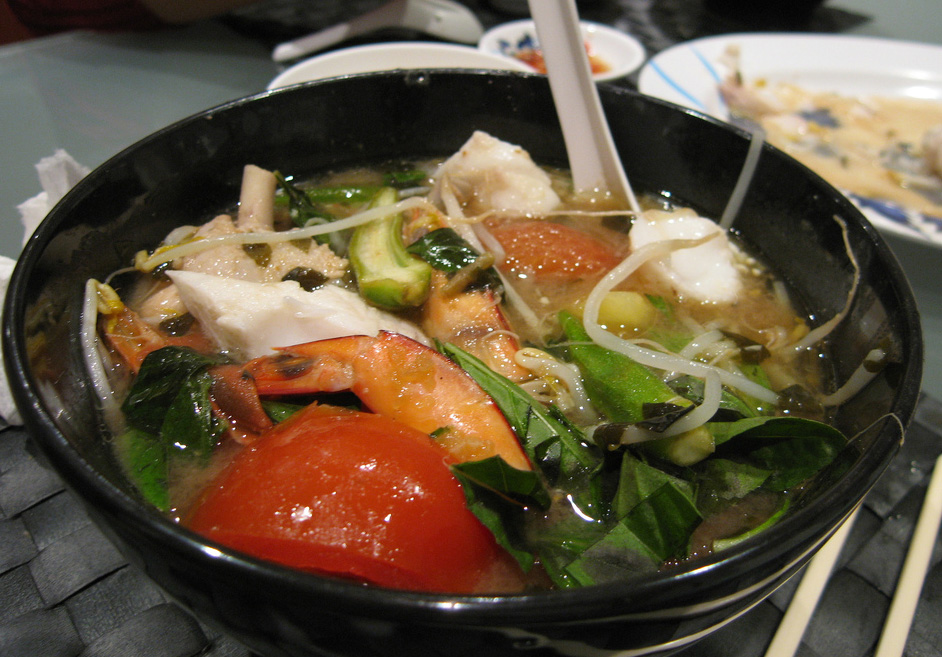
Beautiful photo of canh chua, courtesy of Jason Hutchens

Imagine if you had to go about your everyday life with the inability to smell. It's something that we take for granted, and sometimes we even wish we didn't have (you know those times). But without the ability to smell, the enjoyment of food drastically changes. Probably half the enjoyment behind having great food is taking in the variety of different aromas that culminate together to create this cohesive dish. Think about how much food sucks when you're sick - I personally feel that everything I eat tastes like salted water when I'm not feeling great. I think the best part of eating things like a really good pasta dish is the fragrant basil, or pesto topping, or the deep aromatic tomato sauce. 

So the next time you're out and about town, maybe hanging at your favorite food truck, or dining at that cute hole-in-the-wall lunch joint, take a moment to smell all the different food aromas that are surrounding you. We don't even consider how much smell can affect our interest and desire to take in that additional cake slice, or that additional helping of sour tamarind soup (canh chua) on a cool day. 


Happy dining all! 

PS. If you were interested in learning more about how sensory information like smell and taste is processed in the brain, tune in for next week's posting! 


References:

Scoville et al., 1953. Observations on medial temporal lobotomy and uncotomy in the treatment of psychotic states. Research publications - Association for Research in Nervous and Mental Disease. 31: 347-73.

Scoville et al., 1957. Loss of recent memory after bilateral hippocampal lesions. Journal of Neurology, Neurosurgery and Neuropsychiatry. Feb; 20(1):11-21.  

Eichenbaum et al., 1983. Selective olfactory deficits in H.M. Brain. 106: 459-72.


Saturday, June 15, 2013

Behind the title

Welcome to Amygdaleats! First off, thanks for tuning into this blog - I hope you find it entertaining and informational (or at least enjoy my random ramblings).

I'm a third year graduate student studying how the brain develops specific connections
in both development and following injury to the system. When I'm not at the lab running my experiments, I'm normally at my apartment running culinary experiments from recipes that I either get from friends, other food blogs, or online (I regularly troll Epicurious and allrecipes). While I've always been interested in biology, my love for food and experiencing good, unique foods, ocurred during my undergraduate years where I took up cooking as a hobby and as a stress-reliever. This hobby has turned into an ongoing love-affair that has transformed into trying various recipes at home, to sampling different cuisines while out and about southern
California. My love for all things science and food has been the spearhead of this blog.

And who wouldn't love food?!

Food has so many dimensions, especially in terms of how it relates to science.

1. Food and health: certain foods are great for increasing our well being in preventing disease progression. Think about how many studies are out there about the benefits of red wine, dark chocolate, blueberries or other antioxidant-rich "superfoods" that are published every year (one review of many: Parletta et al., 2013, Journal of Nutritional Biochemistry). We eat certain foods to gain more muscle, be healthier. Then, there's the flip side - how diets rich in saturated fat increase cholesterol and are linked to increased risk of heart disease.


2. Food and emotion: probably one of my best childhood memories was Saturday mornings catching up with my family on daily news over a warm bowl of hu tieu. My mom would make a large vat of delicious pork broth and serve rice noodles over seafood and fresh scallions, bean sprouts and herbs. Now, whenever I have hu tieu at a restaurant, or make it at my apartment, I'm always thinking back on being with my family, comforted by loved ones. Whether it's remembering an important personal event, or remembering an important person, food can illicit some of the strongest emotions. We eat because we're sad, happy, angry, or even just bored. Emotions ranging from extreme pleasure to intense rage are all processed in a subcortical region called the amygdala. Even though the amygdala is most well known for encoding fearful memories, strong emotions can activate the amygdala. Food can even evoke some of the best pleasures known to life - ever experience a "foodgasm?" Whether it's reflecting back on the nostalgic feelings of having hu tieu (seafood noodle soup) crafted by my mom, or enjoying an omakase meal for your birthday, emotional memories of all kinds, even food-related, are encoded in some part by the amygdala.


3. Food and the brain: how exactly is food encoded in our brain? The basis of food relies on the different flavors that come together to make things like a sweet bread pudding, tangy tartare, or savory pesto. Taste itself follows a one cell to one tasting code in order for the information to be neurally processed in our primary taste cortex, the insula. Researchers have even discovered a "map" that has different flavor profiles mapped out in the insula (Chen et al., 2011, Science). The insula isn't the only brain region that's responsible for encoding our perception of food - other parts of the neocortex like the orbitofrontal cortex and subcortical areas like the nucleus accumbens and amygdala are important for our perception of food and pleasure behind scarfing down that umpteenth cookie (reviewed in Berridge et al., 2010, Brain Research - neural regions important for taste reviewed, not why I ate that extra few cookies). All these brain regions collectively compute together all our sensory food information and are responsible for generating that immense pleasure behind digging into a decadent tiramisu after dinner.


Long rant, I know. I promise that this is the last time I ramble about why I love food (hopefully). But you get the general idea behind this blog, and hopefully, you can see the rationale behind the title "amygdaleats." Tune in for more posts ranging from fun recipes to try, interesting reviews on science articles pertaining to food science, or just random postings related to foods!

References:

Parletta et al., 2013. Nutritional modulation of cognitive function and mental health. Journal of Nutritional Biochemistry. May 2; 24 (5): 725-43.

Chen et al., 2011. A gustotopic map of taste qualities in the mammalian brain. Science. Sep 2; 333 (6047): 1262-6.

Berridge et al., 2010. The tempted brain eats: pleasure and desire circuits in obesity and eating disorders. Brain Research. Sep 2; 1350: 43-64.